


My dog is losing hair
In short: a dog sheds hair all year round, and more heavily twice a year, in spring and autumn: this is the moult, the normal renewal of its coat, more pronounced in breeds with a thick undercoat. At these times, the right thing to do is brush more often, with a slicker brush that removes the dead undercoat before it mats: that is the job of our dog brushes and slicker brushes. Hair loss in patches, red or crusty skin, itching, or localised or sudden hair loss are not a grooming matter: it is up to the vet to find the cause.
Is it normal for a dog to shed hair?
Yes. Like cats, all dogs shed hair, and it is the sign of a coat that renews itself, not of a health problem. Each hair grows, lives for several months, stops growing and then falls out to make way for the next one.
This loss stays discreet for much of the year, then speeds up twice a year: these are the moults. The dog then replaces one season's coat with the next. What surprises owners is the volume: on a companion with a dense undercoat, a few strokes of the slicker brush fill the tool, and the sofa is soon covered in hair.
So the quantity alone does not tell you much. A dog that sheds a lot of hair in spring, all over the body, with clean skin and no scratching, is simply following the rhythm of the seasons. What should make you react is the way the hair loss is distributed: that is the subject of the third section.
In which seasons does a dog change its coat?
Dogs change their coat twice a year, in spring and autumn, and each period lasts several weeks. It is day length, more than temperature, that triggers this renewal.
-
PrintempsLe grand renouvellementLa bourre laineuse de l'hiver part en touffes entières chez les chiens à double robe. C'est la période où une séance de carde presque quotidienne change la vie de la maison.
-
ÉtéUne robe allégéeLa perte redevient légère et continue. Une séance par semaine suffit à entretenir la fourrure.
-
AutomneLa seconde muePlus discrète : la robe d'été tombe et une couverture d'hiver plus fournie la remplace. On la remarque surtout dans la carde.
-
HiverUne couverture épaisseLe duvet isole du froid. Il faut le démêler pour qu'il ne se tasse pas en nœuds contre la peau, surtout si l'animal sort sous la pluie.
A dog that lives indoors, in the warmth and under artificial light, sheds hair more steadily and less markedly, whatever its breed: its body receives fewer seasonal signals. This is not an anomaly, it is an effect of its lifestyle.
Normal moult or abnormal hair loss: how can you tell the difference?
A moult thins the coat everywhere at once and leaves the skin healthy; abnormal hair loss forms patches, damages the skin or comes with itching. The useful question is not "how much", but "where and how".
| What you see | What it most often indicates |
|---|---|
| Hair on clothes and furniture in spring or autumn | Seasonal shedding, which is normal |
| The coat thins evenly, the skin stays covered and clean | A change of season, more visible on a double-coated animal |
| A hairless patch, with skin visible in one specific spot | Localised hair loss, to show to the vet |
| Skin that is red, crusty, greasy or strong-smelling | A skin condition, to have examined |
| The dog scratches, licks or nibbles itself constantly | Itching whose cause needs to be found |
| Sudden, excessive hair loss, out of season | A possible sign of an underlying health disorder |
Abnormal hair loss: a matter for the vet
Localised alopecia (a hairless area), itching, redness, crusts or sudden hair loss are not a grooming matter. The possible causes are many: parasites such as fleas or mites, allergies, ringworm, skin infections, hormonal disorders. These conditions look too alike to be told apart by eye, and only the vet can find their cause. A shampoo or a grooming tool maintains a healthy coat: they do not treat a skin disease.
One last guide: a seasonal change sets in, lasts a few weeks and then ends, whereas abnormal hair loss spreads. If it does not slow down, or if a bare patch grows larger, it is time to see the vet.
Which dog breeds shed the most hair?
The breeds that shed the most are double-coated breeds, whose dense undercoat comes out in masses in spring: Nordic breeds such as huskies, shepherds and retrievers. Conversely, dogs with curly or wiry coats shed little, because their dead hairs stay trapped in the coat. Between these two extremes, most crossbreeds have moderate shedding: each breed has its own rhythm, and so does each dog.
| Coat type | Examples | Intensity of renewal | Care |
|---|---|---|---|
| Long and flowing | Yorkshire, shih tzu, Maltese | Moderate, but dead hairs mat quickly | Long, flowing coats |
| Short or medium, double coat | German shepherd, Labrador, golden retriever, husky | Heavy in spring and autumn | Short and medium coats |
| Curly or voluminous | Poodle, bichon frise | Light: dead hairs stay caught in the curl | Curly and voluminous coats |
| Smooth or wiry | Jack Russell, fox terrier, bulldog | Continuous and light | Smooth, wiry and hardy coats |
The undercoat is the key to understanding this. It is a layer of woolly down, beneath the guard hairs, that insulates the dog from cold and heat. This is what comes out in spring. When it is not removed, it packs down against the skin, forms knots and stops the skin from breathing: that is why double-coated breeds need the most brushing.
Which grooming tool to use during the moult?
The right tool is first of all a slicker brush, which catches the dead undercoat deep down, then a softer brush for the finish. Brushing your dog does not stop the shedding: it gathers it in the tool instead of around the house.
The slicker brush has fine, closely set metal pins. Our wooden-handled slicker brush, with steel pins, is used in small sections in the direction of the hair, without pressing: the pins should glide through the coat, not scratch the skin. It is the tool for dogs with an undercoat.
For detangling, the Lady Prestige Démêlage opens up knots on long and medium coats. For smoothing, the Lady Prestige Douce, with ultra-soft bristles, finishes the session and suits sensitive skin and puppies.
Bladed deshedding tools, very effective on the undercoat, should be used in moderation: used too often or too hard, they cut the guard hairs and irritate the skin. During the moult, the clearest results come from short, frequent sessions, almost daily, rather than one long session a week.
Ladybel tip
Settle your companion outside or on a sheet and work from the hindquarters up towards the head, always in the direction of the hair. When the slicker brush brings out almost no dead hair, the session is over: carrying on removes nothing more and tires the skin.
The step-by-step technique, by coat type, is explained in our brushing advice. To compare all the models, see our dog brushes and accessories.
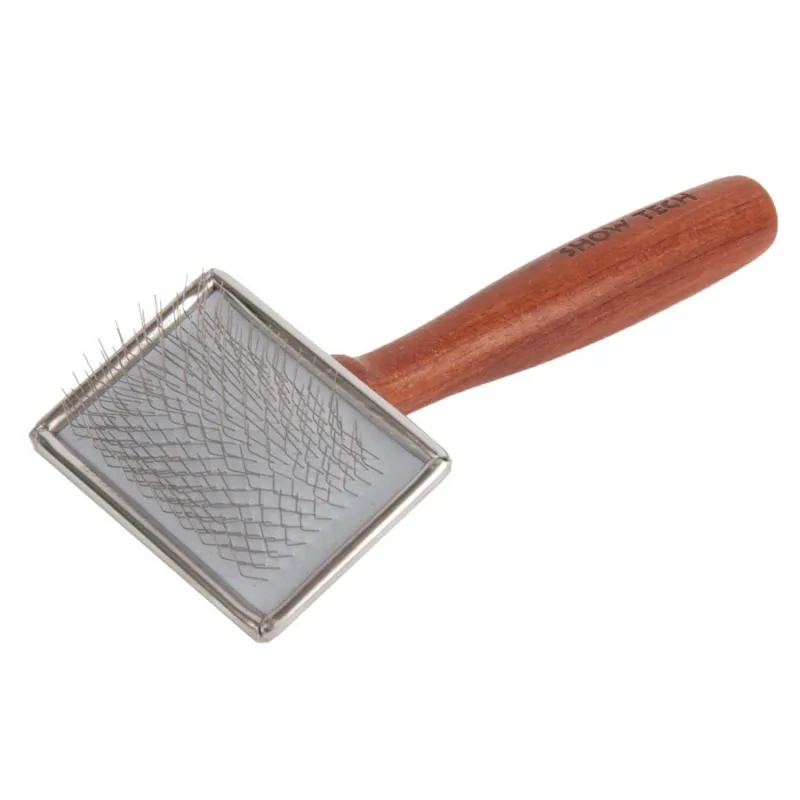
Its fine, closely set steel pins catch the dead undercoat deep down, where a standard brush only skims the surface. Wooden handle, compact size for working in small sections, from puppies to large dogs.
Should you wash a dog in the middle of a moult?
Yes, a well-given bath helps at this time: the water and the massage loosen the dead hairs, which the slicker brush then removes much more easily. The bath does not reduce the shedding: it concentrates it into one session so it is easier to collect. You simply need to detangle before the bath and dry thoroughly afterwards.
Detangle first: wet down that has not been worked through turns into felt. Then wash with a shampoo formulated for dogs, never a product for humans. Our moisturising shampoos Lady Vison and Lady Jojoba clean without drying, and our range of dog shampoos covers other needs. For skin that reacts easily, see our selection of shampoo for dogs with sensitive skin.
On a long or thick coat, a detangler such as Demelex applied before the session lets the tool glide through without breaking the hair; our detanglers and coat care products are made for this. Then dry right down to the roots: an undercoat left damp holds moisture against the skin.
Between baths, a dry shampoo freshens the coat without water. And for the bath itself, our guide how to wash your dog at home details each step. Washing too often strips the skin: in spring, the slicker brush remains the main tool, the bath an extra.
Why does a dog shed hair out of season?
A dog that sheds out of season is often reacting to its environment: heating and artificial light, stress, diet. When these explanations are not enough, the cause should be investigated with the vet.
Heating and light. An animal that lives in warmth and light all year round renews its coat continuously rather than in two clear phases. The total volume is not greater, it is just spread out.
Stress. A house move, a new arrival in the family, a separation, a stay in kennels: a stressed dog may shed more hair for a few days, or lick the same spot until it goes bare. In the latter case, the loss is localised and deserves a professional opinion.
Diet. Hair is made of protein, and a dull coat that sheds too much may reflect an unsuitable diet. Good-quality kibble provides the proteins and fatty acids, including omega 3 and 6, that keep skin and coat healthy. Supplements, omegas included, should not be improvised: for any change of kibble or any added supplement, a vet's advice is worth more than trial and error.
Parasites and allergies. Fleas, mites and allergies are among the causes of hair loss with itching and a skin reaction. These problems are not solved by grooming: they need a diagnosis and a prescribed treatment.
Age and general health. Hair loss accompanied by a change in appetite, thirst, weight or energy may point to wider health problems, to be examined without delay.
When should you see the vet?
Book an appointment with the vet as soon as the hair loss forms patches, the skin is red, crusty or weeping, the dog scratches relentlessly, or the hair loss is sudden and excessive with no link to the season.
In dogs, the vet will then look for the most common causes: parasites, fleas, ringworm, infections, allergy, hormonal disease. Each one calls for its own treatment.
Before the visit, note how long it has been going on, where it is, whether the dog scratches, and what has changed recently (diet, product, home, routine). These details help vets direct their examination of the coat and skin lesions.
A grooming product maintains a healthy coat and skin. It replaces neither an examination nor a treatment, and it cures none of the diseases mentioned here.
Do you have a cat as well? Cats shed hair with slightly different signs: see our page my cat is shedding hair. And to equip your home before the next season, see our dog brushes and slicker brushes.
Not sure which tool or product to choose?
Tell us about your companion's coat, age and what you are seeing. We make these products, so we know which one suits them.
There are 6 products.
Sort by:


