


Dog slicker brush
In short: a slicker brush is a brush with fine, closely set metal pins that removes dead down and undoes small knots before they mat. For a small dog with long, delicate hair, choose a soft model with a small surface, such as our Slicker Brush in size XS or S; for large breeds with a thick undercoat, a wider, firmer model. The golden rule: the pins glide through the coat, they never scrape the skin. The whole range is in our brushes and accessories.
What is a slicker brush for, and when should you choose it over a brush?
A slicker brush removes dead hair and down deep in the coat, where bristles cannot reach. It is the better choice as soon as the animal has a thick undercoat, a coat that forms small tufts, or during the moult.
Among dog brushes, slicker brushes are the most effective on the down, and bristle brushes the gentlest for finishing: to brush a dog with a dense undercoat, you need both.
Its fine, closely set metal pins pass through the top coat and catch the undercoat that has come loose. In fact, the quality of a model is judged by its pins: fine, even, with no sharp edge to snag. Bristles, natural boar or pig hair, work on the surface: they smooth, add shine and spread the sebum, with a light massage. One does not replace the other, they follow each other: the pins prepare, the bristles finish.
A slicker brush also has its limits. On a smooth coat with no undercoat, there is almost nothing to remove. On a tight tangle or matting, the pins must not force their way through: they would tear out the coat and pull on the skin. The detangler goes on first, the slicker brush comes after.
Which model should you choose for your dog's coat and size?
The choice depends on two criteria: the surface, which should match the animal's size and the areas to be worked, and the firmness of the pins, which should match the thickness of the coat. A small dog with fine hair needs a soft, narrow model, large breeds with a dense undercoat a wide, firm one. For a small dog, the brush surface must be able to get behind the ears and under the legs comfortably.
| Coat | Dog size | The model to choose |
|---|---|---|
| Long, fine and silky coat | Small dogs (Yorkshire, Maltese, shih tzu) | Slicker Brush, size S (surface about 7 x 3 cm) for the body |
| Fine, delicate areas | All dogs: head, ears, paws, armpits | The same model, size XS (about 4.5 x 3 cm) |
| Short or medium coat with undercoat | Medium to large dogs (shepherd, retriever) | A wide, firm model, such as the Carde Recta (about 9 x 6 cm) |
| Curly or voluminous coat | Poodle, bichon frise | Size S to open up the curl, then the comb right down to the roots |
| Smooth or wiry coat | Jack Russell, fox terrier | No slicker brush needed: a natural bristle brush is enough |
For complete care of each coat type, see our care pages for long, flowing coats, short and medium coats, curly and voluminous coats and smooth, wiry and hardy coats.
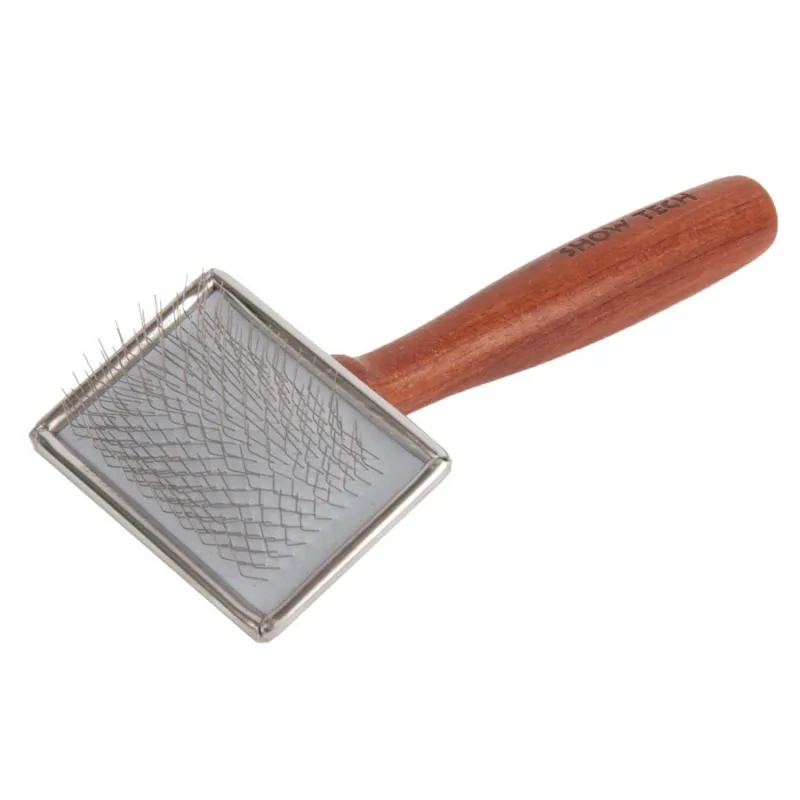
Our soft model, in two sizes. With a wooden handle and steel pins, it is ideal for small dogs with long, delicate hair, and for cats with silky coats that need a gentle touch.
Size XS, about 4.5 x 3 cm: head, ears, paws. Size S, about 7 x 3 cm: the body of a small dog. A product rated by our customers, which is also used for brushing delicate areas.
Our three slicker brushes at a glance. Two other models complement the soft model: a firm model for large coats, and a triangular model for awkward areas.
| Model | Surface | Handle | Best used for |
|---|---|---|---|
| Soft model, two sizes | XS about 4.5 x 3 cm, S about 7 x 3 cm | Wood | Small dogs with long, delicate hair, cats with silky coats |
| Firm groomer's model | About 9 x 6 cm | Curved plastic | High-quality firm model for all coat types, large coats with undercoat |
| Triangular model | About 7.5 x 4 cm | Rosewood, ergonomic shape | Awkward areas: ears, armpits |
The prices and availability of each model are shown on its product page. An ergonomic handle matters as soon as the session lasts a while: it is what keeps your wrist relaxed.
How do you use a slicker brush without irritating the skin?
Hold the tool flat, without pressing, and pass it through small sections in the direction of growth: the pins glide through the coat and stop before the skin.
The five steps below apply to all models. A short, regular session is better than a long one that keeps going over the same spot.
-
Étape 1Préparer la fourrureTravaillez une fourrure sèche, jamais trempée : après un shampoing, attendez le séchage complet. Sur les bourres, vaporisez un produit démêlant comme Demelex et laissez agir quelques minutes : démêler à sec abîme la fibre.
-
Étape 2Garder le poignet soupleL'accessoire suit la fourrure sans pression, picots bien à plat. Si l'animal se raidit ou se retourne, vous appuyez trop.
-
Étape 3Avancer par petites sectionsD'une main, soulevez la robe pour voir la racine ; de l'autre, cardez la mèche du dessous dans le sens de la pousse, jamais à rebrousse-poil, puis descendez d'une section.
-
Étape 4Commencer par les zones qui feutrentDerrière les oreilles, sous les coudes, aux aisselles et à la culotte : c'est là que les bourres se forment en premier. Le format XS est fait pour ces zones.
-
Étape 5Finir aux soies naturellesUn passage de Lady Prestige Démêlage ou de Lady Prestige Douce , aux soies plus souples, lisse et lustre le pelage. Retirez ensuite la bourre restée prise dans les picots.
Caution: sensitive skin and tight tufts
The pins must never force their way through. On a tight knot, first apply a detangler and open it with your fingers or a comb; if the tuft resists, do not pull, as with any knot. On sensitive, red or damaged skin, do not brush the area: any irritation should be shown to the vet. Extensive matting is a job for a professional groomer.
Cleaning takes a minute: remove the hair after each use, with your fingertips or a comb, and store the tool with its pins protected. Bent pins snag the coat: that is the sign it needs replacing. Good use starts here: clean slicker brushes glide better.
How often should you use a slicker brush, especially during the moult?
Outside the moult, a short session once to several times a week is enough, depending on the length and type of coat; during the moult, in spring and autumn, brushing becomes almost daily, in short sessions, to remove the down before it mats.
A long, smooth coat is worked several times a week, a short coat with undercoat mainly during the moult, a smooth coat hardly at all. The best guide remains the pins themselves: when they bring out almost no more undercoat, the session is over. Carrying on tires the skin without removing any more dead hair.
A puppy gets used to it all the better if you start early: a few strokes of the slicker brush a day, a reward, and brushing becomes a daily ritual rather than a chore for the animal.
To understand the moult and recognise hair loss that is not part of it, see our page my dog is shedding hair.
Slicker brushes, bristle brushes, comb: what is the full routine?
The routine comes in three stages: detangling to prepare, slicker brushes to remove the dead down, natural bristles to finish. The comb checks last of all that no tangle remains at the roots.
| Tool | What it does | When |
|---|---|---|
| Detangling spray | Helps the pins glide, opens up tufts, limits breakage | Before brushing |
| Slicker brushes | Remove dead down deep in the coat | At the heart of the session |
| Bristle brush | Smooths, adds shine, massages, cleans the surface | To finish |
| Comb | Checks that no tuft remains at the roots | Last of all |
All our detanglers and brushing care products are gathered in our dedicated section. Between baths, Brushing Powder, a dry care product, is worked into the coat and then brushed out vigorously: it freshens the coat without shampoo or water and coats the hair fibre.
Ladybel tip
Brush outside or on a sheet, starting at the hindquarters and working up towards the head. A treat at the end of each session, and your companion ends up looking forward to it instead of running away, like most pets.
The step-by-step technique, coat by coat, is explained in our guide brushing.
Can you use a slicker brush on a cat?
Yes, with a soft model with a small surface. Our Slicker Brush in size XS or S suits cats with silky coats that need a gentle touch, on the areas where the coat mats.
Be careful with detanglers: Demelex is not for use on cats. Use Lady Magic instead, the product designed for them. And if your cat sheds a lot, you will find guidance on our page my cat is shedding hair.
For the rest of your equipment, see all our brushes and accessories.
Not sure which model to choose?
Tell us about your animal's coat, its size and what you want to remove: we will point you to the right product.
There are 3 products.
Sort by:


